






Why Every Business Needs a Professional Website in 2026
The Digital First Impression Defines Modern Businesses In 2026, a company’s website is no longer a secondary marketing asset or an optional online brochure. It has become the foundation of modern business identity, customer engagement, and long-term growth. Consumers now evaluate companies online before making purchasing decisions, booking services, or contacting sales teams. A professional website acts as the digital headquarters of a business, shaping perceptions within seconds and influencing trust before a conversation even begins. Businesses without a strong digital business presence risk appearing outdated, unreliable, or disconnected from customer expectations in a highly competitive online environment. The importance of a professional website for businesses continues to increase as digital behaviour evolves across industries. Customers expect immediate access to information, streamlined communication, and seamless user experiences regardless of whether they are interacting with a local service provider, retail brand, consultancy, or global enterprise. In many cases, potential clients judge the quality of a company’s services based entirely on the professionalism of its website. Poor design, slow performance, outdated content, or lack of mobile responsiveness can drive visitors away instantly and send them directly to competitors with stronger online platforms. Professional Websites Build Trust and Credibility One of the strongest reasons why every business needs a professional website in 2026 is credibility. Modern consumers are more cautious, research-driven, and selective than ever before. Before contacting a company, they search online for reviews, business information, social proof, and digital legitimacy. A professionally designed website reassures visitors that a company is established, trustworthy, and serious about serving customers professionally. Businesses that invest in professional web design services, website development solutions, and business branding strategies create stronger emotional confidence among potential customers. A polished online presence communicates expertise, attention to detail, and operational reliability. This directly affects conversion rates because visitors are more likely to purchase products, submit inquiries, or request consultations when they feel secure interacting with a legitimate organisation. Credibility also impacts partnerships, recruitment, and investor confidence. Companies increasingly evaluate each other online before entering collaborations or business agreements. A professional website demonstrates stability and long-term vision, helping organisations attract not only customers but also valuable business relationships that contribute to future growth. Search Visibility Drives Consistent Customer Acquisition Search engines continue to play a dominant role in customer discovery. Whether users are searching for products, services, solutions, or industry information, businesses with optimised websites gain significantly more visibility than those relying solely on social media platforms. A business website in 2026 functions as the core of an organisation’s digital marketing ecosystem, allowing companies to appear in search engine results and capture high-intent traffic from potential buyers. The website importance for companies becomes particularly clear when analysing customer acquisition costs. Paid advertising campaigns can generate temporary traffic, but a properly optimised website creates long-term organic visibility that continues attracting leads over time. Businesses that publish valuable content, improve technical performance, and optimise pages for search intent strengthen their rankings and reduce dependency on expensive advertising channels. An effective online presence also allows businesses to target customers based on location, industry, or service needs. Local SEO strategies help nearby customers discover businesses quickly, while broader search optimisation expands visibility nationally and internationally. Organisations that fail to establish a professional website for businesses limit their discoverability and lose significant opportunities for inbound growth. Customer Expectations Have Permanently Changed The digital transformation accelerated over recent years has permanently reshaped customer expectations. Consumers now expect businesses to be accessible online twenty-four hours a day, seven days a week. A website serves as a constant communication channel where customers can learn about services, explore pricing, submit inquiries, read testimonials, or complete purchases without requiring direct staff interaction. This shift has fundamentally changed how businesses operate. Companies that provide clear information, intuitive navigation, and smooth digital experiences retain customer attention more effectively than businesses with fragmented or outdated platforms. A professional website reduces friction during the customer journey, allowing visitors to move naturally from awareness to decision-making. Mobile responsiveness has become especially critical because the majority of online traffic now originates from smartphones and tablets. Businesses that fail to optimise for mobile users risk losing engagement, visibility, and revenue. Fast-loading pages, responsive layouts, and user-friendly interfaces are no longer advanced features; they are baseline expectations that directly influence customer satisfaction and business performance. Professional Websites Increase Revenue Opportunities A modern website does far more than display business information. It creates direct and indirect revenue opportunities across multiple channels. Companies can generate online sales, capture leads, automate appointments, deliver customer support, promote services, and integrate e-commerce systems through a strategically developed platform. Businesses investing in custom website development, conversion-focused landing pages, and e-commerce website solutions often experience measurable improvements in lead generation and sales performance. A professional website works continuously in the background, allowing organisations to scale customer interactions without proportionally increasing operational costs. For service-based businesses, websites streamline the consultation and booking process, improving efficiency while reducing administrative workload. For product-based companies, e-commerce functionality enables sales expansion beyond physical locations and traditional business hours. Even businesses operating primarily offline benefit from digital visibility because customers increasingly research online before visiting physical stores or offices. Data analytics also provide significant commercial advantages. Professional websites allow businesses to track visitor behaviour, identify high-performing content, monitor customer interests, and optimise marketing strategies based on measurable performance indicators. This data-driven approach improves decision-making and increases return on marketing investments over time. Competitive Advantage Depends on Digital Presence Competition in nearly every industry has intensified as businesses adopt digital strategies more aggressively. Companies without professional websites increasingly struggle to compete against organisations that prioritise user experience, online visibility, and digital branding. In many industries, a strong website is now viewed as a minimum requirement rather than a competitive advantage. Businesses with modern platforms position themselves as innovative, customer-focused, and adaptable. Meanwhile, companies relying only on social media pages or outdated websites often appear less professional and less capable of meeting modern demands. Consumers frequently compare multiple providers online before making decisions,

The Power of CRM Automation: How Businesses Save Time and Generate More Leads
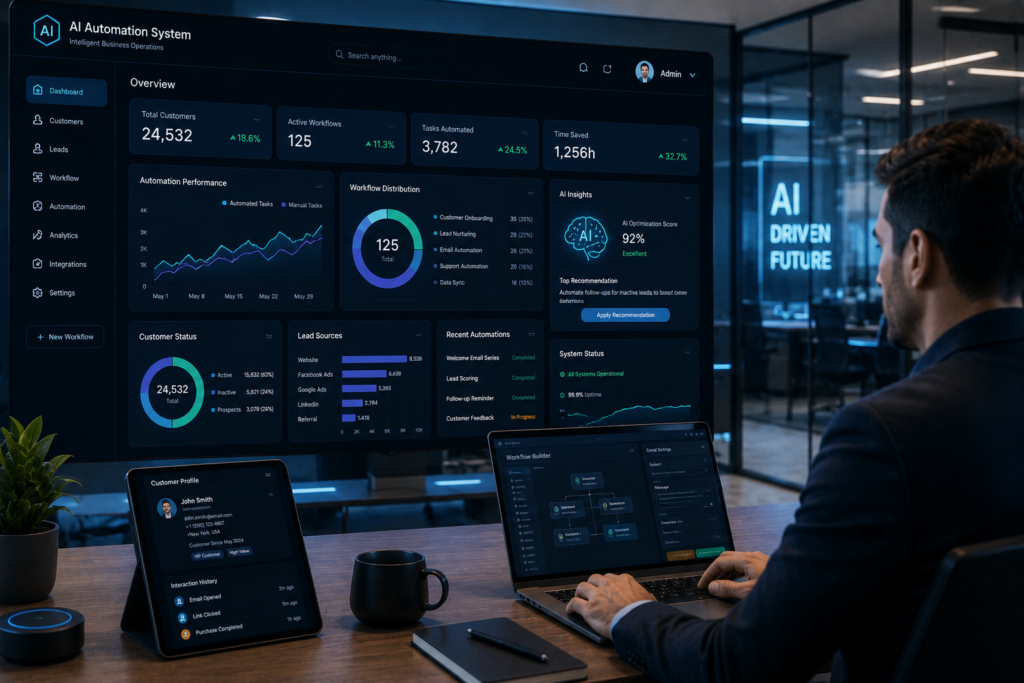
The Power of CRM Automation: How Businesses Save Time and Generate More Leads In today’s highly competitive digital economy, businesses are under constant pressure to improve efficiency, strengthen customer relationships, and increase revenue without dramatically increasing operational costs. This challenge has pushed organizations toward smarter systems that reduce repetitive work while enhancing customer engagement. One of the most transformative technologies leading this shift is CRM automation. Companies across industries are rapidly adopting automated customer relationship management tools to streamline communication, manage leads more effectively, and improve internal workflows. As modern buyers expect faster responses and personalized experiences, businesses that fail to automate critical processes often struggle to remain competitive. CRM automation is no longer viewed as a luxury reserved for large corporations. Small businesses, startups, and growing enterprises are increasingly leveraging automation platforms to manage customer interactions, nurture prospects, and optimize sales operations. The ability to save time with CRM systems while simultaneously improving lead generation has become a major strategic advantage. Instead of relying on manual data entry, disconnected spreadsheets, or inconsistent follow-up practices, organizations are using intelligent automation to create scalable and efficient processes that support sustainable growth. Understanding CRM Automation in Modern Business CRM automation refers to the use of technology to automate repetitive customer relationship management tasks, including lead tracking, follow-up emails, customer segmentation, reporting, appointment scheduling, and workflow management. Rather than requiring employees to manually complete every administrative task, automated systems handle routine operations in real time, allowing teams to focus on strategic and revenue-generating activities. The rise of digital transformation has significantly accelerated the adoption of business automation technologies. Organizations today generate enormous amounts of customer data from websites, social media platforms, advertising campaigns, email marketing, and customer support channels. Managing this information manually is inefficient and often leads to missed opportunities. CRM platforms centralize customer data while automation tools ensure that leads are nurtured consistently and customer interactions remain organized. This technological evolution has fundamentally changed how businesses approach customer relationships. Instead of reactive communication, companies can proactively engage prospects at the right time with personalized messaging. Automated workflows ensure that no lead is forgotten, no follow-up is delayed, and no important customer detail is overlooked. This level of operational precision creates a significant competitive advantage in fast-moving industries. How CRM Automation Saves Time One of the most immediate CRM automation benefits is the dramatic reduction in time spent on repetitive administrative tasks. Sales and marketing professionals often spend a large portion of their day updating records, sending follow-up emails, scheduling appointments, and organizing customer data. These manual activities consume valuable hours that could otherwise be dedicated to building relationships and closing deals. With automation, businesses can create workflows that instantly assign leads to sales representatives, trigger personalized email sequences, update customer profiles, and schedule reminders without human intervention. For example, when a customer submits a contact form on a website, the CRM system can automatically create a lead record, send a welcome email, notify the appropriate sales representative, and initiate a nurturing campaign within seconds. The cumulative impact of these automated actions is substantial. Employees become more productive because they spend less time performing repetitive tasks and more time engaging in high-value work. Teams can handle larger volumes of leads and customer interactions without increasing staffing costs. This operational efficiency improves profitability while reducing employee burnout associated with excessive administrative responsibilities. Furthermore, automation reduces the risk of human error. Manual data entry often results in duplicate records, inaccurate information, or forgotten follow-ups. Automated systems standardize processes and ensure consistency across departments. Accurate data enables better decision-making and allows organizations to respond more effectively to customer needs. CRM Automation and Lead Generation Growth Lead generation remains one of the most critical objectives for businesses seeking long-term growth. However, generating leads is only part of the equation. Companies must also nurture prospects effectively and guide them through the sales funnel. CRM automation plays a vital role in accelerating lead generation and improving conversion rates. Automated lead capture systems allow businesses to collect information from multiple channels simultaneously, including websites, landing pages, social media campaigns, and online advertisements. Once captured, leads can be automatically categorized based on demographics, behavior, interests, or engagement history. This segmentation enables businesses to deliver highly personalized communication that resonates with specific audiences. Personalization has become increasingly important in modern marketing. Customers expect businesses to understand their needs and provide relevant solutions. CRM automation makes this possible at scale. Instead of sending generic marketing messages to thousands of contacts, companies can create automated campaigns tailored to individual customer journeys. Personalized engagement increases open rates, improves trust, and enhances conversion opportunities. Lead scoring is another powerful feature that improves sales efficiency. Automated systems analyze customer behavior, such as website visits, email engagement, and content downloads, to identify high-intent prospects. Sales teams can then prioritize leads that are most likely to convert, reducing wasted effort and improving overall sales performance. Businesses that implement CRM automation often experience shorter sales cycles because prospects receive timely follow-ups and consistent communication throughout the buying process. Speed is critical in competitive markets, and organizations that respond quickly to inquiries are significantly more likely to convert leads into customers. Strengthening Customer Relationships Through Automation Strong customer relationships are essential for sustainable business growth. While automation is sometimes misunderstood as impersonal, modern CRM systems actually enable businesses to deliver more meaningful and consistent customer experiences. Automation ensures that communication remains timely, relevant, and personalized across every stage of the customer journey. Customer retention is often more profitable than acquiring new customers. CRM automation helps organizations maintain ongoing engagement through automated check-ins, personalized recommendations, loyalty campaigns, and customer satisfaction surveys. These interactions demonstrate attentiveness and reinforce customer trust. Businesses can also use automation to improve customer support. Automated ticket routing, instant confirmations, and response tracking allow support teams to resolve issues more efficiently. Customers appreciate fast and organized service experiences, which contributes to stronger brand loyalty and positive word-of-mouth marketing. Another significant advantage is the ability to maintain